I’ve asked once, and I’ll ask again—where is all my Medieval horror?
I finished Christopher Buehlman’s “Between Two Fires” like most readers, absolutely pining for more tales of knights, priests, and warlocks roaming the countryside. Forget the high fantasy stuff; give me stories seeped in bloody lore of King Arthur’s Court, the Black Death, the Inquisition and the barbarous Crusades. History is rife with horror, and no one seems to know this better than Mitchell Luthi.
Luthi is carving out a niche for himself in the historical horror genre, with several of his fictional works focused on the Middle Ages. His previous two books, “His Black Tongue” and “Pilgrim,” were gripping odysseys into European and Far Eastern Medieval terror. He writes with a careful eye for detail and a sharp ear for historicity—but more importantly, he writes with the heart of a modern fantasist, knowing that story and readability are king.
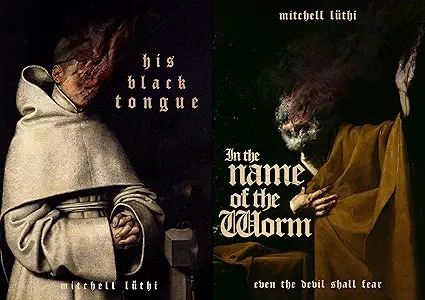
Now, Luthi tightens the thumbscrews once again with his latest serving from the demonic Middle Ages, entitled “In the Name of the Worm.”
Notably, this novel is the second work in a trilogy begun by the novelette “His Black Tongue,” in his same-titled anthology from 2021. This story follows a priest named Pierre on a journey with a young girl named Remi, who is possessed with the supernatural powers of sainthood. They are dispatched to discover stolen relics and root out heresies in central Europe. Along the way, they’re joined by two foul-mouthed mercenaries, a cynical dwarf, and a miller and his daughter, forming a misfit team of adventurers. They stumble across the many hosts of Hell on their journey through Bavaria. As the book’s cover deftly describes it,
“…[this story is] a historical dark fantasy adventure of heretical proportions, complete with lost gods, entombed nuns, witch-knights, and a breathless plot interwoven with a heady dose of heterodox Christian and German folklore.”
The writing stays true to the period without getting needlessly bogged down in political minutia and arcane language. Luthi’s proven himself as a capable writer and researcher, with a deft ear for language and detail. We’re treated to a hefty dose of the stink and squalor of Medieval Europe, with some wickedly salty language. As I said earlier, Luthi clearly appreciates the importance of readability, even at the cost of some modernized language.
More importantly, the book doesn’t waste much time jumping into the action and keeping up a heady pace. The fiends of Hell take a fresh face with every page, which kept me on my toes reading this. There are several episodic adventures, reminiscent of “Between Two Fires.” (No doubt, Luthi will forever find himself compared to Buehlman, although I would argue that Luthi’s work is a worthy corollary, rather than a knockoff of “Between Two Fires.”)
I would offer two minor critiques of the story. The first has to do with the character of Pierre, the main priest. Without spoiling too much, there’s a fairly big revelation about Pierre’s background early in the story that left me scratching my head about how, or why, he is a benevolent priest on this journey. I don’t understand his character arc. (Admittedly, it’s been a few years since I read the original novelette, but I think some kind of preface would have been helpful to get us up to speed.)
My second criticism involves the snarky humor in the story. Granted, this is a personal beef I have with many modern horror stories. It seems like there’s a trend toward writing more and more character as a cheeky, sardonic smartasses, and it just ruins the dread of horror for me.
In the end, though, these distractions didn't stop me from having a wicked fun time reading this book. I would wholeheartedly recommend this novel to anyone hungry for Medieval supernatural terror (yes, Buehlman fans, all of you). We’ll see what’s up next in this blasphemous trilogy, but consider me a faithful reader of Luthi moving forward.
0 Comments Add a Comment?